

Technology validation answers one question: Can we build this wireframe?
Leadership review answers a different one: Should we build this exactly as it is?
That difference matters.
Because leadership isn’t reviewing APIs or routing logic.
They’re reviewing:
- Does this solution directly address the churn problem we identified?
- Are there any compliance or regulatory risks in this design?
- Does this deserve priority over other features right now?
If you don’t run this meeting properly, your simple feature can quietly turn into something much bigger than you planned.
Here’s how to structure the leadership review so that doesn’t happen.
Who should be on this call?
You’ll have the same group of stakeholders who attended the Product Blueprint Review meeting.
- Business Leadership (leaders from Wealth or HNW Banking)
- Product Leadership (leaders from Product, Design, and Engineering)
- Dependency Teams (Compliance, Marketing, Client Support)
In addition to these groups, you also have your technology stakeholders who attended your last meeting.
Walking through the wireframe
Similar to the last meeting, you ask your designer to walk everyone through the wireframe.
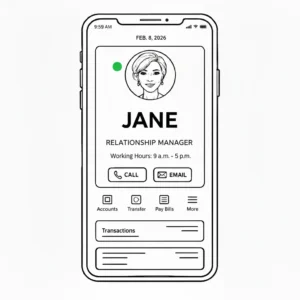
The designer explains both call routing options.
1) Option A: RM call forwarding (best experience)
Calls go directly to the RM when they’re available. When they’re not, calls are routed to an internal support queue. From the client’s point of view, nothing really changes. It’s still one number. One simple flow.
2) Option B: Call-to-message fallback (simpler)
If the RM doesn’t answer, voicemail directs the client to email the RM through the app. That email is automatically copied to an internal support team that can respond if needed.
You also clarify that this feature will be shown only to the one million high-net-worth clients, not to all banking customers (more than 10 million).
Once the designer walks through the wireframe, you open the floor for questions.
You’re going to get a lot of feedback and questions from this group.
Let me show you what might come up.
Compliance might say:
“We need a pop-up message warning high-net-worth clients not to share confidential information since the backup team will also be copied on emails.”
Imagine getting that feedback after the final designs are complete. You’d be redesigning everything.
This is exactly why you’re reviewing wireframes instead of final designs.
But compliance feedback is just the beginning.
Leadership might ask for more features
Stakeholders will suggest additional features. For example, wealth leadership might want a chat feature in addition to call and email.
This is where you push back.
Keep version one simple. Be ready to push back on requests that make your wireframe more complex.
Because here’s what happens if you don’t.
Someone suggests chat. Then video calls. Then appointment booking. Before you know it, you’re building a full communication platform instead of solving the original problem.
This is how feature creep happens.
So how do you push back without offending leadership?
First, acknowledge the feedback. Then provide data to support your recommendation.
You might say:
“That’s great feedback. The data currently shows that email and call are the two most used options by our high-net-worth clients to contact their relationship managers. I recommend we first test these two options, get feedback, and then run a survey to see if clients need a chat option. That way we’re taking a data-driven approach.”
Or, the technology team might chime in and push back on this request themselves.
Someone from the technology team might say:
“We can implement the chat option, but it will take significantly more time. We use a third-party chat platform like Intercom, and integrating that into the mobile app requires custom API work and security reviews. That could add several months to the timeline.”
You’ll also get other questions.
Answer them. If stakeholders have concerns that need deeper discussion, address them separately.
But here’s the question you’ll definitely get:
How soon can we launch this feature?
Here’s what you say:
“We were waiting for approval on the low-fi wireframe. Now that we have alignment, the next step is for technology to provide timeline estimates. I’ll coordinate with them and share final timelines.”
You need to be the single point of contact.
Because you don’t want leadership to hear different estimates from multiple teams. You coordinate the timelines. You communicate them to leadership.
Meanwhile, you set the next steps with technology.
You ask the software architect to start working on the architecture diagram.
At this point, some technology teams might say they need to run a quick proof of concept before they can estimate timelines. And they might need a week or two max.
Remember, these timelines are estimates. They’re not set in stone.
Technology isn’t the only team with next steps.
What dependency teams need to do
Ask the dependency teams, especially marketing and client support, to share their distribution plan.
How will this feature be distributed? How will it be marketed?
As a product manager, it’s your responsibility to ensure the feature’s success. This includes how it’s distributed, even though marketing typically executes the tactics. You need to be aware of the marketing strategy.
For example, they might promote this feature in bank branches. They might run an online campaign announcing the new feature for high-net-worth clients. They might send targeted emails to relationship managers explaining how to guide clients to use it.
Once you’ve covered technology timelines and dependency team plans, you wrap up.
Wrapping up the meeting and next steps
You close the meeting by outlining what happens next:
“We’ll share the final designs and timelines after coordinating with the technology teams. Marketing and client support will present their distribution plan in a separate session.”
With alignment secured, your designer turns the wireframe into final designs.
Once complete, you send them to leadership for approval.
At this stage, leadership shouldn’t request major changes because all you’re doing is adding UI and copy to the wireframe.
The UI is already defined in a design system, a library of reusable components, colors, fonts, and spacing rules that keep the app looking consistent. Leadership can’t give feedback on UI elements because they’re standardized across the entire app.
The only feedback should be on the copy. If you get copy feedback, your content writer makes the changes. Then you share the updated design with leadership once again for approval.
That completes Piece 3 of the fintech puzzle, The Solution Design.
You update the Product Blueprint by attaching the approved final designs to The Solution Design section. The blueprint remains your single source of truth, capturing all five pieces of the puzzle and keeping everyone aligned.
You’re ready for Piece 4, The Solution Build.
But there’s something leadership will want to know first. When will this feature go live?
As we saw earlier in this article, you’ll communicate timelines as a part of The Solution Build. And to give leadership accurate timelines, you need to understand how enterprise fintech software actually gets built and released.
Once you understand this, you can communicate realistic timelines to leadership.