
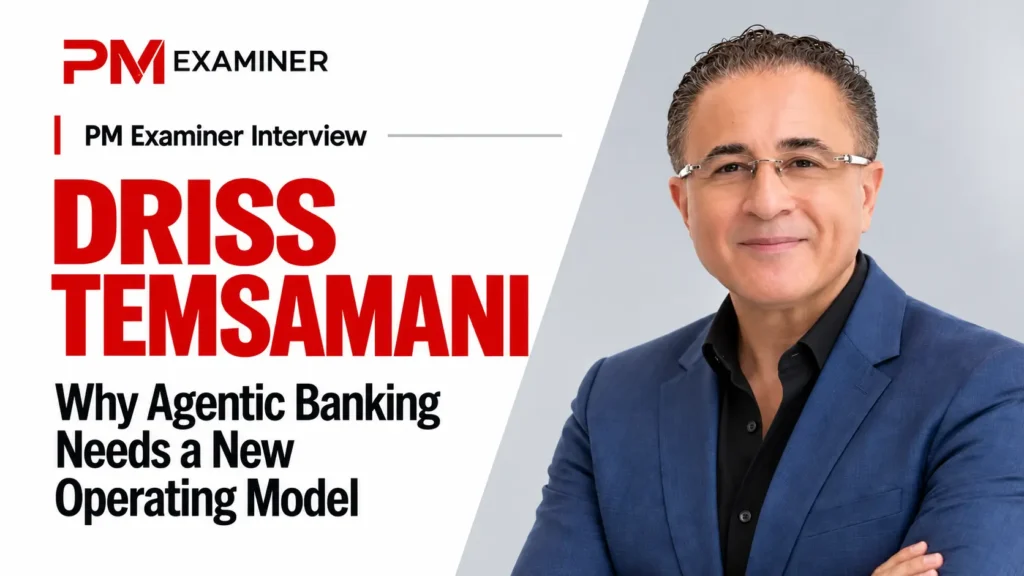
I interviewed Driss Temsamani, Managing Director and Head of Digital for the Americas at Citi and author of The Agentic Bank.
I wanted to make the conversation concrete, so I started with KYC and asked how a bank should think about introducing AI agents into that kind of workflow.
Driss took a step back and widened the frame. In his view, treating KYC, account opening, or another workflow as an isolated AI use case misses the larger shift toward an agentic operating model.
From there, we discussed what that shift means in practice. We talked about fragmented data, organizational change, governance and traceability, technology choices, and why Driss believes these ideas extend beyond banking to what he calls The Agentic Institution.
Use the links below to jump directly to the topics that interest you
- From AI use cases to an agentic operating system
- How fragmented data affects the agentic operating model
- The harder change may be organizational
- Why governance and traceability matter for agent autonomy
- Choosing the right technology for agentic systems.
- From The Agentic Bank to The Agentic Institution
From AI use cases to an agentic operating system
Manu: Let’s take KYC as an example.
Let’s say a bank wants to use AI agents in its KYC workflow. Before it starts building anything, what should it do first, and how should it prepare for the project?
Driss: Let’s take it from the top.
If we go back to the ’70s and ’80s, we were in the process automation era.
We were using technology to drive efficiency by taking manual processes out of the business model and automating them.
Then we went into the era of the Internet, which allowed us, for the second time, to reimagine our business models.
And this went beyond process automation.
It became:
- How do we disrupt businesses?
- How do we go direct to consumers?
- How do we innovate within the business and do something different, potentially outside the core business and within the broader ecosystem?
Then came 2022.
AI had been around for a long time, but 2022 gave businesses and individuals access to AI models in a way they had not had before.
Until then, interacting directly with advanced AI systems had largely been limited to people working in labs.
Then OpenAI gave us access to a model that we could actually have a conversation with.
That allowed us to enter a third phase: What should we do with this? How can we use AI in our business?
The imagination was born again.
First, we used technology to automate processes. Then we used the Internet to disrupt business models. Now the question is: How can we use intelligence?
In particular:
- How can we inject intelligence into processes?
- How can we inject intelligence into our organizational models?
- How can we inject intelligence not only into the digital space, but also into the physical space?
And that’s unique.
At the same time, when you have software writing software and testing software, you enter an exponential trend that is extremely accelerated.
From 2022 to 2026, the progression happened very quickly:
- First, we gained access to models that we could have conversations with.
- Then we connected those models to enterprise data and gave them context so they hallucinated less.
- Then we gave them tools, and they became agentic.
- And now we’re building harnesses around them so that we can give them governance.
That starts to change the architecture of how technology is deployed inside an institution.
Those are the building blocks before we even get into a specific use case.
That is also what prompted my research in 2022.
I started thinking: How can I bring this to my clients? How can I talk about AI now that we have access to it, can experiment with it, and can apply it to use cases or even make it an operating system for the institution?
How can I talk about it in banking language, with corporate treasury and CFOs?
That’s what prompted me to take a lot of my research and put it into a book.
And to your point, I wanted to make it visual.
I wanted people to be able to touch it.
I created a video that I included in the book so that people could actually see it and feel it.
Then I give them an implementation guide covering the technology stack, the formats, the connectivity, and all of that.
If you’re simply trying to improve one part of a bank or institution, then a use case or pilot is fine.
But that is different from treating AI as an operating system for the institution.
An operating system changes not only how you connect with clients, but also how information flows across the organization.
You have to imagine how a typical institution conducts business every day.
It’s a human chain.
Each department has knowledge, expertise, and standard operating procedures that it uses to perform its particular function:
- Sales has its operating procedures.
- Procurement has its operating procedures.
- Legal and compliance have theirs.
- Technology is running code.
- A factory has its operating procedures.
Then you have management layers that bring everyone together.
Every function is doing its job, but something connects all of those functions.
It could be a balance sheet.
It could be a report to shareholders that says: This is how much we’ve produced, how much we’ve made, how much we’ve spent, and this is how profitable we are.
That brings the whole institution together.
When you think about AI, it doesn’t only have to improve one part of the institution.
You mentioned KYC and account opening.
It could also be how you conduct market research, how you develop a product, or how you write a product specification that gets handed off to technology.
These activities involve multiple parts of the institution.
You can bring AI into one of them, but you won’t see the full benefit unless you think about how all of those parts work together as an operating system.
That’s why I talk about creating an agentic harness around the institution.
The harness creates a governance plane for how the institution operates.
No client calls a bank and says, “Open an account,” just for the sake of opening an account.
They want to fund it, make a payment, invest, or support some larger personal or business goal.
So if you only look at the customer process without thinking about what it is ultimately for, and what the human chain looks like beyond opening an account, you really miss the point.
This is our opportunity to use AI for something different from simply process automation or changing a business model.
It can change the way we work and the way public and private institutions operate.
We can move people from lower-value work to higher-value work and reduce the inefficiencies and tedious processes that still consume so much of our time.
To me, that is part of what a truly modern society should feel like.
When you leave your home, when you travel, or when you interact with an institution, you should feel that you are living in a modern society rather than being bogged down by inefficiencies and wasted time.
That requires public institutions, private institutions, and individuals to move together.
And the exponential acceleration I spoke about could allow us to reach that point much faster than previous industrial revolutions.
The acceleration has been fascinating over the last 200 years. I would say about 90% of the technology we use today was invented during that period, and 80% of that has come in the last 40 years.
That tells you that the acceleration in just the last five years is even greater.
Again, software is writing software, and we are becoming less dependent on human skill alone to achieve those innovations.
AI will eventually move from what we would call weak AI toward strong AI and create its own synthetic data so that it can have its own views of the world.
A lot of innovations in the future may come from models.
Things we have not been able to crack for the last 20, 30, 40, or 50 years, AI may be able to help crack in mathematics, physics, biology, and other fields.
So we have an opportunity.
I’m very optimistic about moving toward AI as an operating system rather than treating it simply as a use case or pilot, and about what that means for architecture and organizational structures.
How fragmented data affects the agentic operating model
Manu: Large banks often operate in product and data silos. Doesn’t that make it much harder for them to move toward an agentic operating model, especially compared with fintechs with newer data architectures?
Driss: Well, this is a challenge for all institutions, really.
It’s not just banks. It’s the way technology was created for its time.
What you’re describing is the ancient problem of the database.
The database holds the rules for the department that created it.
In a traditional institution:
- Marketing goes to technology and says, “I need you to build me a CRM for sales.”
- Legal says, “I need you to build me a platform.”
- HR says, “I need you to build me a platform.”
Technology ends up servicing multiple departments across the institution.
That’s simply how the architecture evolved.
Even if you create a data lake, what you have primarily done is bring information together using common data standards. That allows you to do better analytics and reporting.
But the database remains the core engine containing the rules and transactions.
Legacy systems aside, what we’re really talking about here is architecture.
What we now have is an opportunity to rethink the database.
This is what I call the smart data fabric.
The smart data fabric starts with what institutions have already built as a data lake, data warehouse, or broader big-data environment.
But now you begin bringing three other things into that environment:
- identity
- rules
- governance
That means an agent doesn’t have to navigate across individual systems throughout the firm and deal with all of that fragmentation and latency.
It can go directly to the smart data fabric.
Think about the rules that exist inside a CRM, Workday, or an ERP.
Those rules can be extracted and brought into the data environment, which also has identity and governance built into it.
That becomes particularly important for agent-to-agent orchestration.
The transactional database can remain for transaction purposes, while the smart data fabric handles more of the routing logic.
The next opportunity comes when AI meets blockchain.
Eventually, all of this becomes tokens.
The models and tools become token instructions.
Now imagine that intelligence leaving the digital environment and interacting with infrastructure for clearing. If that infrastructure is also tokenized, whether through a stablecoin, a central bank digital currency, or another tokenized ledger, then you begin connecting intelligence directly with tokenized value.
You start moving away from the idea that you need one place to hold payment history, another KYC database, another statement database, and so forth.
Now you have tokens connecting with tokens, and intelligence connecting with tokenized value.
In the book, I have a chapter called “AI Needs Blockchain.”
That’s the convergence I’m describing.
From 2026 to 2030 and in the years that follow, I think there is an opportunity for the world to become organized around intelligence, tokenization of value, and tokenization of intelligence.
Why?
Because we need to move toward higher-value work and higher-value problems.
There is still paperwork. There are still inefficient processes. There is still friction between the physical and digital worlds.
We haven’t yet fulfilled the promise of what this could look like.
If you’re like me and you already have an agentic harness and deployed agents helping you organize parts of your life, you can begin to feel what that future might look like.
You can start to feel it at work and at home.
And that’s just a glimpse of what this world could potentially look like once we reach those levels.
The harder change may be organizational
Manu: Beyond the technology, what has to change inside a bank for this agentic model to work?
Driss: I think the hardest part is going to be at the human level, the organizational structures.
I think the technology is here, and software writing software is going to accelerate everything.
Of course, we need governance.
Money, value, and relationships are built on trust. If you lose trust, everything crumbles.
So we have to get the governance right.
With regulations and the proper rules of the road, I think that part will eventually settle down.
But to me, governance is only the tip of the iceberg.
The much bigger question is: How do we redesign people around this new way of working and around new organizational structures?
We have to reimagine the org chart.
That’s where the rubber meets the road: the legacy mindset versus the new AI mindset.
You and I may already have made that shift in how we think.
But that doesn’t mean the hundreds of thousands or millions of people around the world who work every day and have access to this technology have made the same shift.
The cost of AI is going to be relatively clear. We’ll know how much we’re paying.
But measuring the impact is going to be much harder unless we also change the organizational model.
Manu: Does that change have to come from the top?
Driss: From executives, yes, but there also has to be a mindset shift.
You can’t force it.
We need to reach that sweet spot where, if people find value in something, they look for it, seek it out, and want to pay for it.
It becomes something they actively pursue.
I think we need to stop talking about AI.
For me, I want to wake up one day and not see AI mentioned everywhere.
I’m old enough to have grown up with DOS and WordPerfect.
There was a time when people talked about things like: How fast can you type? Can you use word processing? Can you do desktop publishing?
Those were skills people talked about as requirements for getting a job.
Eventually, we stopped talking about them because we had adopted them.
They became invisible, and we simply saw the value and the impact.
To me, that’s when you and I can have another conversation and I’ll say, “Yeah, we’ve reached that point.”
We’re good now.
Why governance and traceability matter for agent autonomy
Manu: In a regulated industry like banking, how much autonomy should AI agents have? And what needs to be in place before banks can move them from pilot to production?
Driss: I recently wrote an article about this.
In The Agentic Bank, I spent a lot of time talking about governance and risk management.
And while the book is called The Agentic Bank, for me it’s really about The Agentic Institution. I wrote it broadly enough that the ideas can apply to any industry.
Governance is critical.
The challenge with agentic orchestration is that once data is used in an intent or prompt, whether through RAG, an injected file, or some other source, you need traceability from that point all the way through to the output, especially if that output leaves the institution.
That’s why we need to apply the same mindset we use for data lineage.
You need lineage throughout the transformation.
As information moves from the prompt through the agentic system and downstream, there needs to be an envelope around it that determines:
- what it should carry
- what it should not carry
- what it can disclose
- what it should not disclose
Without that traceability and lineage, you’re operating with high risk.
And that risk doesn’t affect only your own institution. A serious failure can slow adoption across an entire industry.
That’s why the architecture has to include governance from the beginning.
You need the governance layer, the envelope, the explainability console, and the right KPIs.
Without those capabilities, you’re not really building the system properly.
Again, the limitation isn’t the technology.
It’s the design.
Choosing the right technology for agentic systems.
Manu: How much of a bank’s existing technology can be reused as it scales agents? And where does it need to build or partner?
Driss: Well, look, this technology is expensive.
So one of the key design decisions is where you use frontier models versus small language models for specific use cases.
You also have to understand what crosses institutional boundaries. That becomes especially important in a regulated environment.
And this isn’t specific to banks.
The same principles apply whether you’re a pharmaceutical company, an airline, a government, or a social security department.
You need things like:
- architecture and agent harnesses
- explainability and governance
- envelopes around how information moves
- traceability and data lineage
All of that needs to be embedded in the architecture.
It’s not a lack of technology.
It’s a design question: What do you build, and what do you partner on?
You’re not going to build your own data center, acquire your own GPUs, and build your own frontier models. There are only a handful of labs doing that.
So you’re going to partner with them.
But you may build local models for specific use cases and use generic frontier models for others.
That choice is part of the design.
And AI itself is a very broad term.
Are we talking about generative AI? Machine learning? Computer vision? Robotics?
You have to choose the right technology for the problem.
For example, you’re not going to use generative AI for a use case where machine learning is better suited to detecting anomalies.
Those can be local models already running inside the company using Python and other technologies.
I know some of this sounds mystical, but it really isn’t.
A lot of it comes back to basic cloud-computing questions:
- How do you design the harnesses?
- How do you structure and standardize the data?
- What stays on premise?
- What goes off premise?
There are certain things that are simply table stakes, whether the system involves AI or not.
From The Agentic Bank to The Agentic Institution
Manu: I know you’re working on another book. Without giving too much away, what are you exploring next, and how does it build on The Agentic Bank?
Driss: The Agentic Bank came out of that particular moment when generative AI was suddenly in our hands.
I started thinking: How can we use this? How can I talk about it with corporate treasurers and CFOs?
I wanted to get those ideas out to the audience I interact with every day.
But for me, it was always about The Agentic Institution.
It’s almost like I started at the end of the movie and I’m now walking backward toward the beginning.
The Agentic Bank looked at these ideas through the narrower lens of banking.
Now I’m expanding that view and asking: What should an institution more broadly be thinking about?
I’ll be looking at examples across:
- procurement
- factories
- physical AI
- agentic commerce
- treasury
And showing how all of those pieces come together.
Basically, from a widget in a factory all the way through procurement systems, purchase orders, invoices, and treasury, it all becomes part of the same story.