Author: Manu

  • How to Extract Insights From Client Interviews (Part 1)—Making Sense Of Each Interview

    How to Extract Insights From Client Interviews (Part 1)—Making Sense Of Each Interview

    You’ve interviewed churned retired business owners, passive heirs and active clients from both segments.

    You now have hours of recordings and pages of notes.

    The next step is to turn those conversations into insights.

    This article shows you how to make sense of individual interviews. How to break down each conversation, extract what matters, and decide whether to keep going or stop.

    Let’s start with what to do right after each interview.

    Transcribe and review each interview

    After each interview, transcribe the recording using ChatGPT or any transcription tool.

    Print the transcript.

    Then read it with a pen in hand. Highlight key moments and mark anything that stands out. 

    Why paper? 

    Because screens make you skim but paper forces you to slow down and think.

    As you read, you’re trying to answer five questions:

    1. What outcome was the client trying to achieve?
    2. Why were they trying to achieve it?
    3. Why couldn’t they achieve it?
    4. What challenges did they face along the way?
    5. What alternatives did they do instead?

    These questions help you uncover the core problem. The actual breakdown in the client’s experience.

    Let’s apply them to the retired business owner interview.

    Example: Debriefing the retired business owner interview

    1) What outcome was the client trying to achieve?

    The client needed to transfer large sums of money from Canada to the US on a regular basis.

    2) Why were they trying to achieve it?

     They had became a snowbird. They were spending winters in the US, setting up a second home, buying a car and managing major cross-border expenses.

    3) Why couldn’t they achieve it?

     Their relationship manager was unavailable. Large transfers required the manager’s approval due to transaction limits and cross-border rules. Without that approval, the transaction couldn’t proceed.

    4) What challenges did they face?

    The client called the general support line from a US number. The system didn’t recognize them as high-net-worth and routed them into the regular queue.

    After multiple security checks, they reached the high-net-worth support team. But that team couldn’t approve the transfer either. Only the relationship manager had the authority.

    There was no documented backup relationship manager. No one owned the client’s context in the manager’s absence.

    5) What did they do instead?

    The client used another bank to transfer the funds.

    This is how you debrief each interview. 

    Evaluate the interview process itself

    Before you schedule the next interview, pause and ask one question:

    Should you keep going with the same questions, adjust them, or stop interviewing altogether?

    There are three valid options.

    Option 1: Don’t change anything

    This is common early on, when you’re still learning how a segment thinks.

    If the first few retired business owners give very different accounts of how they handle transactions, keep the script as is. You need more interviews to find the common thread.

    Don’t tweak the questions yet. You don’t have enough data to see patterns.

    Option 2: Adjust your questions

    This happens when you start hearing the same answer again and again for a particular question.

    A question has done its job. It’s no longer revealing anything new.

    For example, if every retired business owner describes the baseline relationship in the same way:

    “The relationship manager was always available.”

    At that point, you don’t need to keep asking about the baseline. Update the script and spend more time on what changed and why the relationship broke down.

    Make this adjustment only after the same answer repeats across several interviews.

    Option 3: Stop interviewing

    Sometimes you reach saturation.

    You hear the same core problem from four or five clients in a row. The story doesn’t change. The challenges stay the same.

    For example, you might hear the same story from four retired business owners. They can’t reach their relationship manager. There’s no visible backup. Transactions stall. At that point, interviews five and six are unlikely to reveal anything different.

    That’s your signal to stop.

    At this point, the work shifts from interviewing to synthesis.

    What comes next

    You’ve debriefed each interview and decided whether to keep going, adjust, or stop.

    Now you have a stack of debriefs. One for each interview.

    The next step is to step back and look for patterns across all of them.

    That’s Part 2.

    In the next article, you’ll learn how to find common problems across interviews, separate symptoms from root causes, and decide which problems actually deserve attention.

    For now, focus on doing the basics well.

    Debrief each interview carefully.

    Answer the five questions.

    Evaluate your process.

    Get this right and everything that follows becomes much easier.

     

  • How To Interview Clients Like A Therapist And Find Out Why They Left

    How To Interview Clients Like A Therapist And Find Out Why They Left

    Have you ever been to a good therapy session?

    If you have, you know the therapist doesn’t start by asking about your deep childhood traumas. 

    That would be insane.  

    Instead, they build trust first. They talk about the weather. Maybe ask about your day.

    Then they work to understand your context. What’s happening in your life. What’s changed recently. What patterns are emerging.

    Only after this groundwork do they dive into your problems.

    Why?

    Because without trust, people give surface-level answers. 

    Without context, problems get misdiagnosed. 

    Without safety, people hold back their real issues.

    Client interviews work the same way.

    Build trust first. 

    Understand the context next. 

    Then create space for deep sharing where clients can open up without feeling judged.

    This structure helps you understand the problem that caused clients to leave in their own words. 

    You’ll use this approach when interviewing the right clients: churned retired business owners, passive heirs, and the same segments among active clients.

    In this article, I’ll walk through an interview with a churned retired business owner. The same principles apply to the other segments.

    Before getting into the interview, it helps to answer one simple question.

    Do you need an interview script?

    Yes. You need a script.

    You should have two core scripts: one for churned clients and one for current clients. The script for current clients should then be tailored to each persona.

    That said, don’t treat the script like a checklist. The goal isn’t to get through questions. It’s to understand the problem in the client’s own words.

    The script also serves a practical purpose. It can be reviewed by compliance to ensure you don’t ask questions that create legal risk.

    With that in place, the interview itself takes about 45 minutes and is divided into three phases.

    Let’s walk through each one.

    Phase 1: Building trust (5-10 minutes)

    This phase is about establishing rapport.

    Start with a few minutes of small talk. Ask about their day or weekend plans. Keep it light.

    Remember, churned clients expect a sales pitch. Many are frustrated before the call even begins. Address that upfront.

    What to say: 

    “Thanks for the time. I know you’ve moved your accounts, and I’m not trying to win you back. I’m a Product Manager. My only job is to understand where we failed you so we can improve how we serve clients in similar situations. You have the perspective we need.”

    Next, ask for permission to record the interview. Be clear that the recording is for internal research only.

    What to say: 

    “I’d like to record the interview to focus on listening instead of taking notes. The recording is for the internal product research only and won’t be shared with sales or marketing. Is that OK?”

    Phase 2: Understanding the client’s context (10 minutes)

    In therapy, this is where the conversation starts broad.

    The therapist asks about routines, recent changes, and what life looked like before things shifted.

    Do the same here.

    Start by establishing the baseline. Ask the client to recall a time when things were working well.

    What to say: 

    “Think back a few months when things were smooth. Walk me through a typical week working with us.”

    What you’ll hear: 

    The relationship manager was always available and acted as a trusted owner of the client’s entire financial life. They had a deep understanding of the client’s assets, liabilities, family context, and long-term goals.

    Next, identify the shift.

    What to say: 

    “What changed? When did the experience start to feel different?”

    What you’ll hear: 

    Interactions with the relationship manager became more frequent. When the manager was away, the client couldn’t reach anyone. They didn’t know who the backup was or whether one existed.

    This wasn’t an issue before as transactions were infrequent and predictable. Waiting a few days felt fine.

    Now it didn’t.

    One critical rule here: don’t correct the client.

    If they say, “The bank has no backup for my relationship manager,” and you know a backup team exists, don’t challenge them. 

    Focus on the client’s reality – even if it’s incorrect. 

    This is how you uncover the real issue: not that a backup didn’t exist, but that it was invisible to the client.

    Now narrow in on why they were trying to contact their manager more frequently.

    What to say: 

    “Tell me more about why you needed to reach your relationship manager more often.”

    What you’ll hear: 

    Last year, the client became a snowbird.  They started spending winters in the US. That shift changed everything.

    Before, banking was simple. Transactions were infrequent and predictable.

    Now they were building a second life. Setting up a second home. Buying a US car. Handling major expenses across the border. This meant moving a lot of money between Canada and the US regularly.

    But there was a catch.

    Large transfers required relationship-manager approval due to bank limits and cross-border regulations.

    Suddenly, reaching the manager wasn’t a convenience. 

    It was critical.

    The snowbird insight is key. When insights like this emerge, follow the thread. Set the script aside and explore it fully. This is often where the most valuable discoveries surface.

    Phase 3: Deep sharing (25-30 minutes)

    In a therapy session, this is when the client feels safe to discuss specific moments where the relationship broke down.

    This phase uncovers the core problem that caused churn.  

    Spend 25-30 minutes here, as this is where the most valuable insights come from.

    Dig deeper into their challenges with higher transactions.

    What to say: 

    “When you realized your relationship manager was away, how did you handle that large transaction from Canada to the US? Walk me through it.”

    What you’ll hear: 

    The client called the general support line.

    Usually, this is straightforward. When they call from their Canadian number, the system recognizes them instantly. They get fast-tracked to the high-net-worth team with zero wait time.

    But this time, they were calling from a US number. The system didn’t recognize them. It treated them like a regular client.

    General support line agents had to ask multiple security questions to validate their status before routing them to the high-net-worth support team.

    What to say: 

    “What happened next? Did the high-net-worth support team assist you with the transactions?”

    What you’ll hear:

    The support team couldn’t approve the transfer.

    Due to cross-border compliance rules, only the relationship manager could approve high-value transactions. They were the only person with full visibility into the client’s risk profile and history.

    The support team looked for the manager’s backup. But no formal backup was on file for this client.

    Since the manager was away, the authority to sign off couldn’t be transferred to anyone else.

    The client was told to wait for the manager to return to work.

    Eventually, the case was escalated to senior management. But that added more reviews and more delay.

    What to say: 

    “I’m sorry to hear this. Since you couldn’t wait, how did you move your funds?”

    What you’ll hear: 

    The client used another bank with operations in both Canada and the US. 

    What this interview revealed

    Earlier, you learned that retired business owners value ownership.

    They want one person who carries their financial context and takes responsibility over time.

    This interview shows what happens when that ownership disappears.

    When the relationship manager was unavailable, trust eroded. Backup existed, but the client couldn’t see it. Support teams were helpful, but lacked authority.

    The issue wasn’t transaction limits.

    It wasn’t a missing process.

    It was the loss of personal accountability.

    These clients don’t just need access. They need someone who carries their context and can act when it matters.

    When continuity broke, the relationship collapsed.

    And with it, the bank lost advisory fees, referrals, family relationships, and years of future value.


    Next Article: How to Extract Insights from Client Interviews (Part 1) – Making Sense of Each Interview

    Previous Article: How To Identify Which Clients Are Churning (The Target Audience)

  • How To Identify And Reach The Right Clients For Interviews

    How To Identify And Reach The Right Clients For Interviews

    The pattern was clear: 70% of churn came from retired business owners.

    But knowing who’s leaving isn’t enough.

    The next piece of the puzzle is understanding why they left.

    That requires talking to the right clients and listening carefully.

    This is where things get difficult.

    High-net-worth clients ignore interview requests. Their time is scarce. Their schedules are guarded. Gift cards and vouchers don’t cut it. A $50 incentive won’t sway someone with millions in net worth.

    They engage only if they believe the conversation will lead to real change.

    So how do you reach them and get them to show up?

    This article shows how to do that in three practical steps:

    Step 1: Determine who to interview and in what order
    Step 2: How to reach them
    Step 3: How many to contact and how to schedule

    Step 1: Determine who to interview (and in what order)

    You can’t just interview churned retired business owners and stop there.

    You also need to talk to retired business owners who haven’t churned yet. If they’re experiencing the same issues, you still have a chance to fix the problem before they leave.

    The next highest churn comes from passive heirs. 

    Together, retired business owners and passive heirs make up 70% of the client base.

    Any solution you build for retired business owners must not break the experience for passive heirs. That’s why you need to include both groups in your interviews.

    Start with churned clients. They reveal what broke.

    Then talk to current clients. They show you what’s starting to fray before it turns into churn.

    Step 2: How to reach them

    Reach out to churned clients as someone from the client satisfaction team. 

    Don’t pitch. Don’t sell. Don’t pretend you’re trying to win them back.

    Say this explicitly: 

    “I’m trying to understand why you left. I’m not trying to win you back or sell you anything. I want to understand where confidence in the relationship broke down, so we can improve how we serve clients in similar situations going forward.”

    The ideal place to meet these clients, especially those currently churning, is during exit interviews. Join those meetings as churning clients are already in feedback mode.

    For current clients, reach out through their relationship managers. Ask them to make the introduction. A referral from a trusted advisor dramatically increases response rates.

    Make it easy for them to introduce you. Give them an email template and talking points. Follow up regularly. Relationship managers are busy, and without reminders, your request drops off their list.

    Step 3: How many to contact and how to schedule

    Aim for about six interviews per segment. Beyond that, you start hearing the same things over and over. 

    In this case, four segments mean 24 interviews. 

    Assuming a 20% response rate, reach out to 120–150 people. 

    Avoid over-recruiting. Contacting 200 people and interviewing only a fraction creates a poor experience for those who agree but never hear back.

    A few simple scheduling principles make these interviews far more effective:  

    • Don’t pack interviews back-to-back. Context switching drains energy. Leave time to capture insights before the next call.
    • Group similar audiences. Interview churned clients on one day and current clients on another. This makes it easier to compare perspectives.
    • Block 15–30 minutes after each call to document insights  while they’re fresh.

    Being thoughtful about spacing and sequencing improves the quality of every conversation. 

    Remember the problem?

    High-net-worth clients ignore interview requests. Their time is scarce. Their schedules are guarded.

    So how do you get them to show up?

    Start with churned clients. They reveal what broke.

    Then talk to current clients. They show what’s starting to fray.

    Reach out with clarity and intent. Don’t sell. Don’t pitch.

    Six interviews per segment is enough. Be thoughtful about outreach and scheduling.

    For customer interviews, especially with hard-to-reach audiences, a clear outreach process makes all the difference.

    Without one, responses are rare.

    With one, even busy clients respond.

    Identifying the right clients is only the first step.

    In the next article, we’ll look at how to interview clients like a therapist and uncover why they really left.


  • How To Identify Which Clients Are Churning

    How To Identify Which Clients Are Churning

    In the last article, you found a massive problem.

    Churn in the high-net-worth (HNW) business jumped by 10% in one quarter. For a bank with one million HNW clients, that means 100,000 people walking out the door in just 90 days.

    You panicked. So you jumped into brainstorming mode.

    “Let’s add an app feature.” 

    “We need better onboarding.” 

    “What if we improve the dashboard?”

    Ideas flew. You felt productive.

    But one question went unanswered: 

    Which clients are actually leaving?

    Without that clarity, every solution is a guess. You build features for the wrong segment. You launch campaigns that don’t resonate. Sometimes, you even accelerate the churn you’re trying to stop.

    To find out who is really leaving, you have to move from assumptions to evidence.

    It happens in three steps:

    Step 1: Segment your clients

    Step 2: Identify which segments are churning

    Step 3: Understand what their churn costs you 

    Step 1: Segment your clients 

    Most banks segment clients by wealth.

    High Net Worth.

    Very High Net Worth.

    Ultra High Net Worth.

    High Net Worth segmentation

    Wealth segmentation explains where the revenue sits. It doesn’t explain behavior.

    If your data shows 10% of churn is happening in the HNW segment, one thing is clear: Revenue is leaving. Beyond that, the data stays silent.

    Wealth bands capture financial impact. They don’t tell you how clients interact with the bank, what they expect, or why they quit.

    To understand churn, you need to shift your focus. Stop looking at how much clients have and start looking at how they behave.

    A practical way to do this is to segment by age, source of wealth, and interaction patterns. These factors shape how clients consume advice and build trust.

    Here’s one way to approach it:

    • Retired Business Owners
      Exited founders in their 60s–70s with complex financial lives. They value clear ownership, continuity, and deep understanding of family and estate context.
    • Passive Heirs
      Inherited wealth later in life. They value reassurance, careful guidance, and time to build confidence before acting.
    • Entrepreneurs
      Active or semi-active founders. They value speed, decisiveness, and clear authority.
    • Professionals
      Time-poor executives. They value simplicity and low-effort financial management.
    • UHNWI
      Ultra-wealthy clients with family offices. They use banks selectively for execution and leverage.

    The takeaway is simple: clients with similar wealth behave very differently. And they churn for different reasons.

    Step 2: Identify which client segment is churning

    Once you segment churned clients by behavior, a pattern emerges.

    Retired business owners made up 45% of your clients, yet accounted for 70% of the churn. 

    Typically aged 60–75 and no longer active in the business, this group prioritizes capital preservation and the smooth transfer of wealth to heirs. They pay high private-banking fees, hold massive investable assets, and use nearly every product the bank offers.

    Because of this scale and complexity, their expectations are different.

    They value a mature Relationship Manager (RM) who clearly owns the client relationship. One person accountable for family finances, trusts, and long-term planning.

    Other client segments behave differently.

    Passive heirs are typically middle-aged and have recently inherited wealth. Their primary goal is maintaining their lifestyle while minimizing risk. For them, security matters more than performance.

    Instead of ‘ownership,’ heirs look for guidance and reassurance. Success comes from an RM who explains options, oversees the portfolio, and advises on major decisions like tax optimization.

    Treating high-net-worth clients as one segment ignores these differences and leads to dissatisfaction and silent churn.

    Step 3: Understand what their churn costs you

    When a retired business owner leaves, advisory fees disappear. Assets move out. Lending income drops. Even referrals dry up.

    Their churn wipes out multiple revenue streams at once.

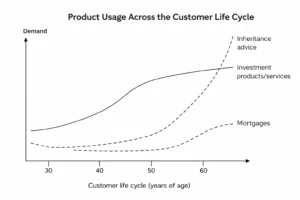
    To see what’s at stake, look at client lifetime value.

    High Net Worth Product Usage cycle

    Client value isn’t just today’s revenue. It compounds over time.

    As clients move through life stages, their banking needs evolve. Early on, they pay basic private-banking fees. In their peak years, they drive investment growth. In the later stages, they focus on wealth transfer and estate planning.

    Retired business owners generate value year after year. They bring not just revenue, but also referrals, family relationships, and long-term continuity.

    Losing them weakens the bank’s core economics.

    Remember the brainstorming session?

    • “Let’s add an app feature.”
    • “We need better onboarding.” 
    • “What if we improve the dashboard?”

    None of those ideas addressed the real problem: who was actually churning. 

    To answer that, we segmented clients by behavior instead of wealth bands. The pattern became clear. Most of the churn was coming from retired business owners, the segment that generated the most value for the bank.

    The brainstorming failed because it started with solutions instead of understanding the problem.

    Now you know who is churning.

    The next step is to understand why.

    That requires interviewing the right clients. That’s where the next piece of the puzzle begins.

  • How to Build a Fintech Feature That Actually Solves a Real Customer Problem (An In-Depth Series)

    How to Build a Fintech Feature That Actually Solves a Real Customer Problem (An In-Depth Series)

    Building a fintech feature is like solving a five-part puzzle in a sequence. Each piece must be completed in the right order. When all five pieces come together, the customer problem is solved.

    In this series, I’ll show how that puzzle plays out in practice, using a real-world problem from the high-net-worth (HNW) banking space.

    Let’s start by looking at the puzzle itself.

    Imagine you are a product manager working in the high-net-worth (HNW) division of a Canadian bank.

    The bank serves one million HNW clients. These clients hold significant assets and pay for premium banking and advisory services. They typically use multiple products: mutual funds, credit cards, and lending.

    Each client is assigned a Relationship Manager (RM) who acts as the primary point of contact. Clients may work with specialists for estate planning, real estate financing, tax matters, or investment advice. But they don’t have to manage those relationships on their own. 

    The RM brings in the right specialists, stays accountable for outcomes and maintains continuity across the client’s financial affairs. 

    As a result, clients experience the bank through their relationship manager. Trust and confidence are shaped by how well the RM understands the client’s situation and takes responsibility for outcomes over time. 

    Now, leadership notices a serious problem.

    Churn in the high-net-worth business has increased by 10% quarter-over-quarter.

    For a bank with one million HNW clients, that means 100,000 clients leaving in just 90 days.

    That’s the puzzle we need to solve.

    The Five-Piece Puzzle

    To solve this puzzle, five pieces must be put together in the right order:

    1. The Target Audience
    2. The Customer Problem
    3. The Solution Design
    4. The Solution Build
    5. The Launch and Iteration

    Each piece depends on the one before it. 

    Before we dive deep into each piece in the upcoming articles, let’s briefly look at what each one covers and why the sequence matters.

    Piece 1: The Target Audience

    You first need to understand which customers are experiencing the problem.

    In this case, which clients are leaving?

    If you don’t know who is churning, you can’t know why they’re leaving.

    You’ll learn how to segment churned clients step by step and identify the audience most affected.

    We won’t just stop there. 

    You’ll also assess the business impact of this churn and quantify the revenue at risk.

    Piece 2: The Customer Problem

    Once you know who is churning, the next question is why?

    The only way to answer that is to interview your clients. Both the ones who left and the ones who stayed. 

    Identify the right clients to interview and figure out how to reach them.

    Run these conversations like a therapist would. Build trust first. Understand their context next. Then create space for deep sharing where clients open up without feeling judged. This approach helps you understand what caused clients to leave in their own words.

    Once the interviews are complete, debrief each one.

    Then step back and look for patterns across all conversations. Prioritize the problems that led to churn. Decide which one to tackle first, which comes next, and which can wait.

    Document these findings in the Product Blueprint. This becomes your single source of truth.

    Finally, build alignment with leadership by presenting the Product Blueprint.

    Piece 3: The Solution Design

    Now that you understand the problem, the next step is designing a solution.

    But design in fintech does not start with screens. It starts with identifying constraints such as regulatory requirements, internal processes, and card network rules like Visa and Mastercard.

    Ignoring these constraints leads to months of wasted work. Design creates detailed screens, leadership approves them, engineering begins development, then compliance says, “This violates regulatory requirements.” The feature gets scrapped.

    That’s why constraints come first.

    You translate the customer problem into a mockup screen, which is what we call a low-fidelity wireframe.

    Then you ask: Can this actually be built within our technology constraints?

    You’ll also need to understand how a fintech app screen gets built before moving to final designs.

    Before finalizing, review these wireframes with leadership and compliance to avoid rework later.

    Piece 4: The Solution Build

    With validated designs in place, the next step is building the solution.

    But before any code is written, you need to answer one question: How will you measure success?

    You measure success by defining key metrics that show whether the feature is solving your churn problem.

    You’ll also see how enterprise fintech features get built in stages across multiple teams, with each team working in parallel before integrating their work together.

    Before development starts, you break the work into sprints and estimate timelines to align with engineering and leadership.

    Piece 5: The Launch and Iteration

    Once the feature is built, you don’t launch it to everyone at once.

    You release it to a small group of users first to see how they use the feature, whether there are any technical issues, and to get their feedback. This is called pilot testing.

    Only after this do you launch it to the whole group. Then you measure whether the feature actually solved the churn problem. You track metrics like contact rates, response times, escalations, asset outflow, and most importantly, whether churn declined.

    What’s Next?

    Building a fintech feature is like solving a five-part puzzle in sequence.

    Each piece must be completed in the right order. First, The Target Audience. Then, The Customer Problem. Next, The Solution Design. After that, The Solution Build. Finally, The Launch and Iteration.

    In the upcoming articles, we’ll dive deep into each piece of this puzzle.

    We’ll start with the first piece: The Target Audience.

    When all five pieces are in place, the “customer problem” is solved.

    Let’s begin.

PMExaminer

How AI agents get built for banking

Twenty Twenty-Five

Designed with WordPress