

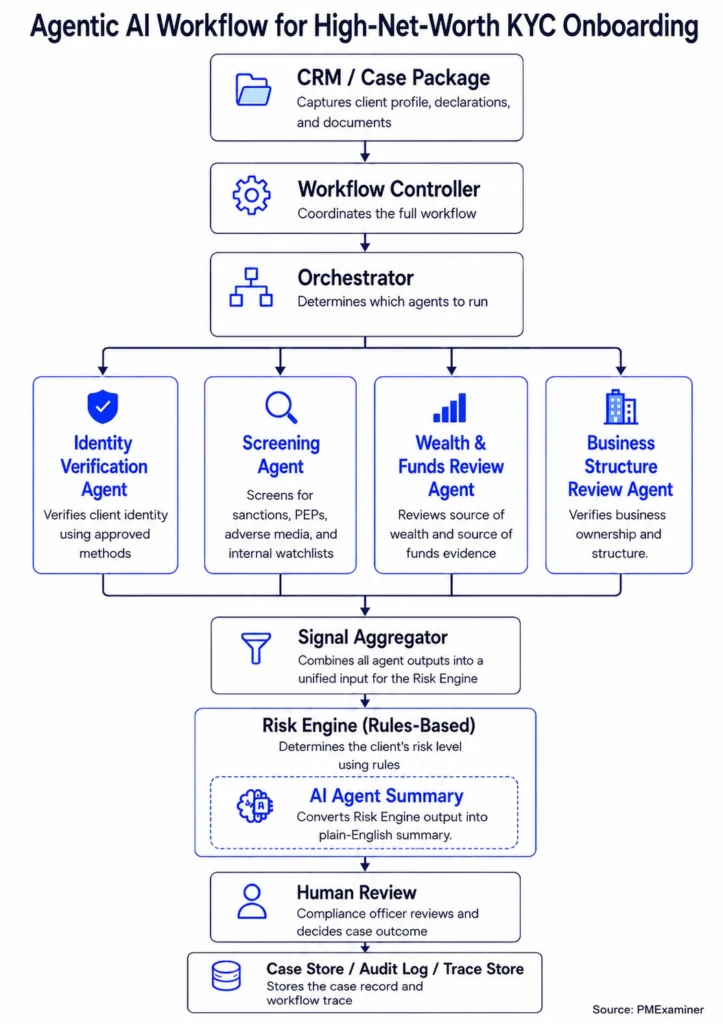
In this series, we are building an agentic KYC workflow for high-net-worth onboarding piece by piece.
- The full agentic KYC workflow and architecture
- The CRM and Case Package layer
- The Workflow Controller
- The KYC Orchestrator
- The Identity Verification Agent
- The Screening Agent
- The Wealth And Funds Review Agent (this post).
I also built a working prototype in Python to demonstrate this architecture. You can find the link to the prototype here.
James sold his software company last year for $18 million.
He now wants to open a new bank account with a Canadian bank and transfer $5 million into that account.
Of that $5 million, $4 million comes from the business sale proceeds he currently holds in his existing bank account. The remaining $1 million comes from crypto funds held through a crypto exchange.
The bank cannot open the account based only on what James has declared. It needs to understand where the $5 million will come from.
The $5 million James wants to transfer raises two different questions.
- Can the bank confirm the business sale and the source of the $4 million James plans to transfer?
- Can James show where the remaining $1 million in crypto funds came from?
Two separate agents need to answer these questions.
The Business Structure Review Agent answers the first question. It checks whether James owned the software company and whether he plans to transfer the $4 million from those sale proceeds.
The Wealth and Funds Review Agent answers the second question. It checks the $1 million James plans to bring in from crypto funds.
This separation becomes important when the client’s business structure is more complex.
Imagine a client with several businesses.
One business may be owned through a holding company. Another may be connected to a trust. Funds may pass through several companies before they reach the client’s personal account.
Now imagine one agent trying to understand structures like these across thousands of clients.
It would need to examine the companies, the ownership links, and the funds connected to the business. At the same time, it would need to check the client’s personal wealth and funds.
That would give one agent two very different responsibilities.
So the workflow separates them.
The Business Structure Review Agent focuses on the companies, the ownership links, and the funds connected to the business.
The Wealth and Funds Review Agent focuses on the client’s personal wealth and funds.
This makes each review easier to understand, test, and explain.
In this article, I will explain James’s business sale briefly so that the $5 million he wants to transfer is easy to follow. But the Business Structure Review Agent handles that review.
I will break down the Business Structure Review Agent in more detail in a future post.
For now, we only need to see how the $4 million James plans to transfer came from his business sale.
James says he received $18 million from selling shares in his software company.
To check that declaration, the Business Structure Review Agent uses the business sale agreement James provided. The agreement may show:
- James’s name as the seller;
- the shares he agreed to sell;
- the name of his software company;
- the buyer’s name;
- the $18 million sale amount; and
- the closing date or closing terms.
But the agent does not rely only on the document James provided.
It may also check an official corporate registry. In Canada, this could be Corporations Canada if the company was federally incorporated, or a provincial registry if the company was incorporated provincially.
The registry helps the agent check whether the software company exists and whether James was connected to it.
But the registry does not show that James sold his shares for $18 million or that he received the sale proceeds.
To check that, the agent uses the sale documents and James’s existing bank account statement to see whether money from the sale came into his account.
In James’s case, the statement shows that he received the $18 million from the software company sale in his existing bank account.
He plans to transfer $4 million from that account into his new bank account.
James has not sent the money yet. So the bank cannot confirm that the $4 million came from his existing account during onboarding.
For now, the bank can establish that James plans to fund the new account with $4 million from the account where he received the business sale proceeds.
Once James makes the transfer, the bank can confirm whether the $4 million came from that account.
Now let’s turn to the part handled by the Wealth and Funds Review Agent.
Can James show where the remaining $1 million will come from?
James has not transferred the remaining $1 million into the new bank account yet. So the Wealth and Funds Review Agent first checks whether he can show where that money will come from.
To do that, the agent uses the crypto exchange account statement James provided.
The statement may show:
- his name as the account holder;
- the name of the crypto exchange;
- the value of the crypto funds held in the account; and
- the amount available for withdrawal or transfer.
This helps the agent check whether the account belongs to James and whether it has enough funds for the planned $1 million transfer.
But the statement only shows that James holds crypto funds in his exchange account. It does not show how he acquired those funds.
If the bank needs more evidence, the agent can request James’s crypto transaction history or other records showing how he acquired the funds.
The agent may also use an approved crypto transaction screening tool, such as Chainalysis or TRM Labs. The tool checks whether the available crypto transactions show links to sanctions, stolen funds, or scams.
These checks answer three different questions.
| What the agent checks | Evidence or source the agent may use |
|---|---|
| Does the crypto exchange account belong to James, and does it hold enough funds for the planned $1 million transfer? | Crypto exchange account statement |
| Can James show how he acquired the crypto funds? | Crypto transaction history or other records that James provides |
| Do the available crypto transactions show anything the bank needs to review further? | Approved crypto transaction screening tool |
If the agent can answer these questions, it can support James’s declaration that he plans to fund $1 million of the new account from his crypto exchange account.
The agent now needs to return what it found to the Workflow Controller.
What does the Wealth and Funds Review Agent return to the Workflow Controller?
The Wealth and Funds Review Agent has now checked the crypto funds James plans to bring into the new account.
It has checked:
- whether the crypto exchange account belongs to James;
- whether the account holds enough funds for the planned $1 million transfer;
- whether James can show how he acquired the crypto funds; and
- whether the available crypto transactions identify anything the bank needs to review.
After these checks, the agent returns one of three findings to the Workflow Controller.
1. The documents and sources support what James declared
If the documents and other sources support James’s declaration, the agent returns:
Status: COMPLETED

Source of funds reviewed:
James plans to transfer $1 million from his crypto exchange account.

Finding:
The documents and other sources support James's declared crypto funds.

Sources checked:
- Crypto exchange account statement
- Crypto transaction history
- Approved crypto transaction screening tool

Next step:
Confirm the actual incoming transfer once James funds the new account.
The Workflow Controller can then send this finding to the Signal Aggregator.
2. The agent completes its review and identifies missing evidence or a clear issue
Sometimes the agent can complete its review and identify a specific issue.
For example, James may show that his crypto exchange account belongs to him and holds enough funds for the $1 million he plans to transfer. But he may not provide enough records to show how he acquired those crypto funds.
He may also provide his crypto transaction history.
But those records may still not explain how he originally acquired the crypto funds.
In that case, the agent can clearly state what the available evidence shows and what remains unverified.
STATUS: COMPLETED_WITH_SIGNAL

WHAT THE Available Evidence SHOW:
- James's crypto exchange account belongs to him.
- The account holds enough funds for the planned $1 million transfer.
- The available crypto transaction history was reviewed.

SIGNAL IDENTIFIED:
- The source of James’s crypto funds was not established from the available evidence.

EVIDENCE STILL NEEDED:
- Other records showing how James acquired the crypto funds

SOURCES CHECKED:
- Crypto exchange account statement
- Crypto transaction history

NEXT STEP:
Send the finding and identified signal to the Signal Aggregator.
The same approach applies if the crypto transaction screening clearly identifies a concern connected to James’s crypto funds. The agent can include that issue in its finding, and the Workflow Controller can then send the finding to the Signal Aggregator.
3. The agent needs human input before it can complete its finding
Sometimes the agent cannot complete its review without human input.
For example, the bank may use two approved crypto transaction screening tools to check James’s crypto funds and receive different results.
CRYPTO SCREENING TOOL A: No concern identified.

CRYPTO SCREENING TOOL B: Possible concern identified.

STATUS: HUMAN_REVIEW_REQUIRED

WHAT THE Available Evidence SHOW:
- James's crypto exchange account belongs to him.
- The account holds enough funds for the planned $1 million transfer.

ISSUE REQUIRING REVIEW:
Two crypto transaction screening tools returned different results for James's crypto funds.

SOURCES CHECKED:
- Crypto exchange account statement
- Crypto transaction screening tool A
- Crypto transaction screening tool B

REVIEWER FOCUS:
Review the conflicting crypto screening results and decide how the bank should treat the planned $1 million transfer.
The Workflow Controller pauses this part of the review and sends the specific issue to a compliance officer.
Once the compliance officer decides how the bank should treat the issue, the agent can complete its finding. The Workflow Controller can then send it to the Signal Aggregator.
This gives the Wealth and Funds Review Agent three possible outcomes:
| Agent outcome | What it means | What happens next |
|---|---|---|
COMPLETED |
The available evidence supports James’s planned $1 million transfer from crypto funds. | The Workflow Controller sends the finding to the Signal Aggregator. |
COMPLETED_WITH_SIGNAL |
The agent completes its review and identifies missing evidence or a clear issue. | The Workflow Controller sends the finding and identified issue to the Signal Aggregator. |
HUMAN_REVIEW_REQUIRED |
The agent cannot complete its finding without human input. | The Workflow Controller pauses this part of the review and routes the specific issue to a compliance officer. |
These outcomes need to be built into the Wealth and Funds Review Agent.
The agent should know when to complete its finding, send a clear issue to the Signal Aggregator, or request human input.
The agent must also adapt to different sources of personal wealth and funds
The agent must do more than return a finding. It must also check the client’s personal wealth and funds based on where the client says the money came from.
For example, a client may say their wealth came from selling real estate. The Wealth and Funds Review Agent would need to check the property sale evidence and the money the client received.
Another client may say their wealth came from an inheritance. The agent would need to check the inheritance documents and the money transferred to the client.
So the Wealth and Funds Review Agent cannot follow one fixed path. It runs the checks that apply to the client’s declared personal wealth and source of funds.
Let’s quickly recap
The Wealth and Funds Review Agent checks what the client declared about their personal wealth and source of funds against documents, bank records, and reliable external sources.
It then returns a clear finding to the Workflow Controller. That finding may show that the available evidence supports what the client declared. It may identify missing evidence. Or it may explain an issue that needs human review before the workflow can continue.
That is how the Wealth and Funds Review Agent turns a client’s declaration into a finding that the rest of the workflow can use.
In the next post, we will look at the Signal Aggregator and how it brings the agents’ findings together.